
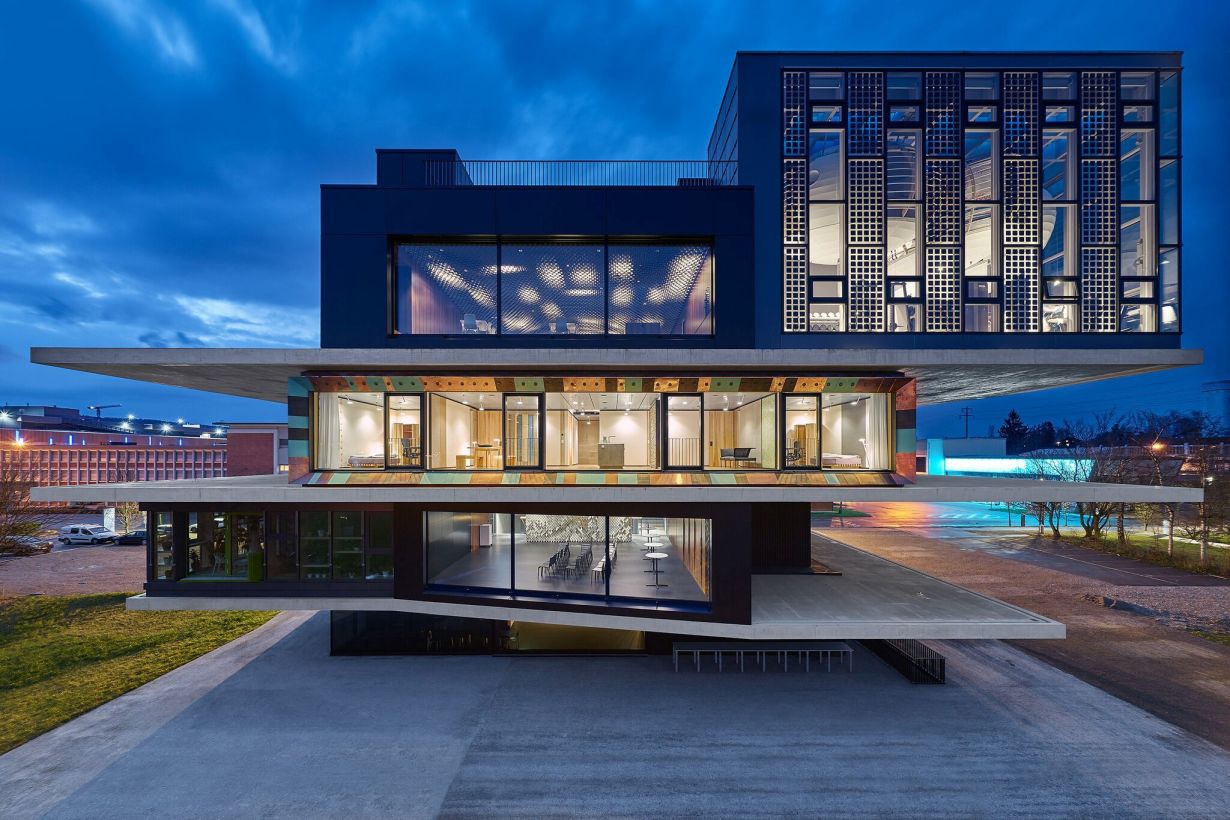
Global population is growing – and with it the need for living space. But conventional construction materials are running short. The Urban Mining and Recycling Experimental Unit near Zurich exclusively consists of compostable, recyclable, and reusable construction materials. The combined laboratory and home is to push change towards circular economy in the construction sector. It was developed jointly by researchers of Karlsruhe Institute of Technology (KIT) and the Werner Sobek Office.
The building design was created by Werner Sobek, Dirk E. Hebel, and Felix Heisel. Professor Sobek heads the Institute for Lightweight Structures and Conceptional Design of Stuttgart University, Professor Hebel heads the Sustainable Construction Group of KIT, and Heisel is responsible for its research activities. “We want to demonstrate that buildings can be constructed such that all materials used can be disassembled and separated afterwards,” Hebel says. For the three-room apartment of 125 square meters, primary resources, such as untreated silver fir wood, were used, but also elements applied at other places before, recycled wastes, and newly developed construction materials. The copper plates framing the facade formerly covered the roof of a hotel in Austria, the door handles come from a bank in Brussels. The building rubble was turned into new bricks, beverage carton packages were converted into wall coverings. The residential unit, hence, is an example of urban mining: construction materials come from other buildings and everyday objects. While natural resources, such as sand or copper, become scarcer, the man-made environment may serve as a big source of materials. “Using this urban warehouse of materials enhances sustainability and makes us more independent of the raw materials market,” says Felix Heisel. Instead of bonding or foaming joints, screwing, clamping or plugging were preferred to ensure later recycling and reuse of the materials. In addition, entirely new construction materials were applied, such as compostable insulation boards made of mycelium, a material consisting of fungal tissue and saw dust.
The pilot project for sustainable construction created in close cooperation with industry and the crafts sector was opened in spring 2018. To test various construction materials, construction elements can be exchanged easily. For five years now, researchers will study whether the methods used will stand the test and how the construction materials will behave. Scientific assessment will also consider the experience gained by two students who moved into the three-room apartment in May. The Urban Mining and Recycling Experimental Unit was fully prefabricated at the factory and integrated in a multi-storey test building within one day. The NEST (Next Evolution in Sustainable Building Technologies) research building is located on the campus of the Swiss Federal Laboratories for Material Science and Technology in Dübendorf near Zurich, Switzerland. International research teams from universities, universities of applied sciences, architectural offices, and construction companies joined forces in NEST. “By testing innovations under real conditions, we bridge the gap between research and application, because circular economy needs new methods and products,” Hebel emphasizes.
More information: www.nest-umar.net
Read more about the “Urban Mining and Recycling Residential Unit” and about sustainable resource management in the current issue of our research magazine lookKIT https://www.sek.kit.edu/english/2142.php.
Additional materials:
Digital press kit:
http://nest-umar.net/press-kit/
In close partnership with society, KIT develops solutions for urgent challenges – from climate change, energy transition and sustainable use of natural resources to artificial intelligence, sovereignty and an aging population. As The University in the Helmholtz Association, KIT unites scientific excellence from insight to application-driven research under one roof – and is thus in a unique position to drive this transformation. As a University of Excellence, KIT offers its more than 10,000 employees and 22,800 students outstanding opportunities to shape a sustainable and resilient future. KIT – Science for Impact.