
Magnetic Fingerprints Point to Natural Hydrogen
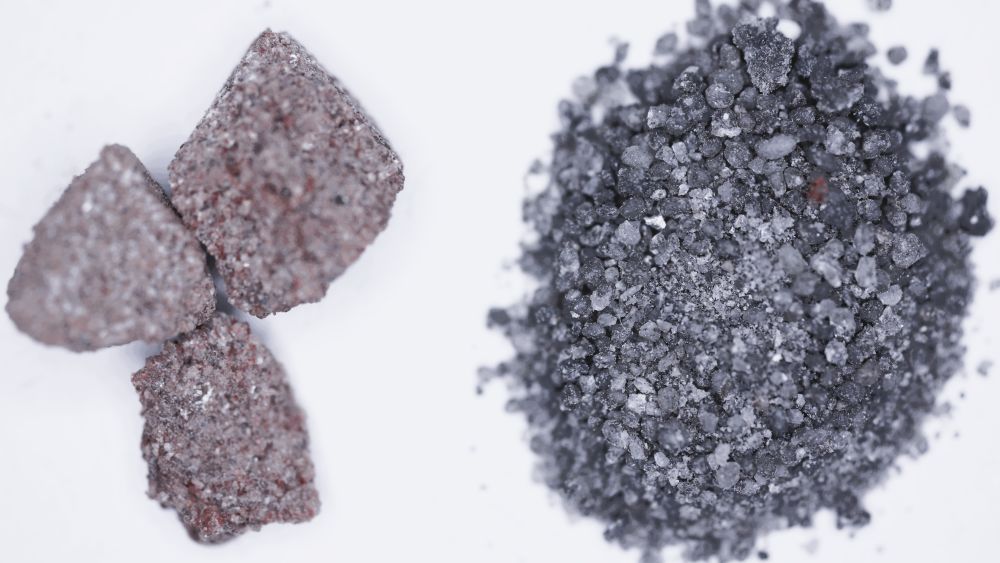
So far, only limited methods exist to detect natural hydrogen in the subsurface. Researchers at the Karlsruhe Institute of Technology (KIT) have now identified a novel approach to trace this promising energy resource. In experiments, they demonstrate that hydrogen can significantly alter the magnetic properties of rocks. The findings suggest that this mechanism may generate measurable magnetic anomalies – potentially providing new indicators of hydrogen in the subsurface.
Hydrogen Leaves Measurable Signatures in Rocks
“We were able to show that, at moderate temperatures, hydrogen can convert the widely occurring iron mineral hematite into magnetite,” says Dr. Bruno Mendes from KIT’s Institute of Applied Geosciences (AGW). “This increases the magnetic activity of the rock by several orders of magnitude.” In laboratory experiments, the researchers exposed rock samples to hydrogen at 200 degrees Celsius over several days. This process produced extremely fine magnetite particles, which significantly enhanced the magnetic signal of the samples.
A key requirement for the reaction is that the water produced during the transformation can drain away, making the rock structure an important controlling factor. Highly porous sandstones show a much stronger response than dense or cemented samples. “For natural hydrogen exploration, the crucial point is that such reactions can generate detectable signals,” explains Dr. Chaojie Cheng (AGW). “In the future, magnetic measurements could help to better constrain and target the search for subsurface hydrogen.”
mhe, April 14, 2026